
The "Cool" Pope
Nike and The Politics of Counterculture

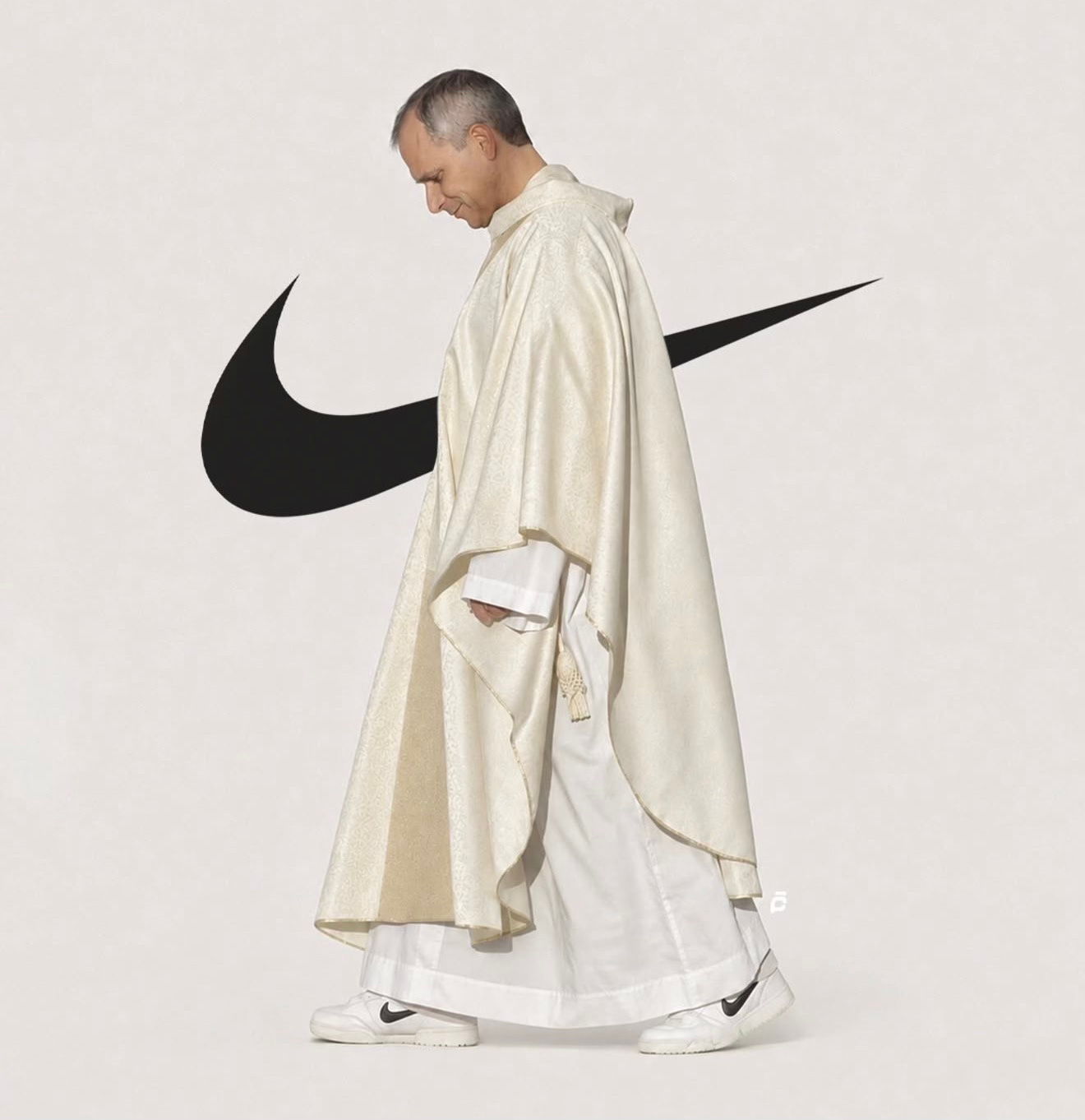
The Pope is not supposed to have “drip.”
That is the unspoken rule. The papacy is one of the last institutions in the world that resists fashion trends entirely. Instead, its authority and image are built on repetition: white robes, red shoes, gold rings. For centuries, this visual continuity has been designed to signal permanence rather than personality.
And yet, somewhere between Vatican formality and internet circulation, an image of Pope Leo XIV wearing Nike sneakers began to move.
It’s a small detail — almost absurd in proportion to its impact. A white cassock, a ceremonial setting, and the unmistakable curve of a swoosh at the edge of the frame. Not staged or announced, but entirely visible.
The strange thing is not that the image spread, but how quickly it earned the American pontiff internet approval.
Within hours, Pope Leo XIV had been absorbed into a familiar internet narrative: the “cool” pope. Not cool in a theological sense, and not even cool in a political sense, but cool in the way the internet currently recognizes legitimacy — through vibes, proximity, and selective humanization.
The fact that he is Chicago-born only sharpens the effect. It collapses the distance we normally feel with heads of the Church. Suddenly, the papacy is not just a remote European institution speaking Latin in Mass, but something faintly domestic. Instead, as a global religious authority, Pope Leo XIV has been translated through a quintessentially American cultural shorthand: sneakers, background familiarity, and a kind of unforced relatability that the internet is unusually quick to reward.
But what does it actually mean?
Of course, it does not mean doctrinal agreement. Most people circulating the image are not evaluating papal theology or applauding the institution of the Church. They are responding to something faster and more informal: a sense that this figure sits slightly outside the norm, and just might be like us.
Part of the reason the image has travelled so easily is that Pope Leo XIV has already been absorbed into a counterculture. In a polarized media environment, even symbolic gestures from the Vatican are immediately sorted into familiar political categories. When the Pope wears sneakers and voices criticism of figures like President Donald Trump, or merely aligns himself with concerns about nationalism, migration, or economic inequality, those moments do not remain theological. They become signals — compressed into a shorthand, indicating which side of the cultural atmosphere he belongs to.
And once that happens, the rest of the image gets reinterpreted through the same lens.
The Nike sneakers are no longer just sneakers. They become a kind of visual confirmation of a perceived orientation: not institutional distance, but cultural softness toward the language of critique, irony, and global cosmopolitanism that the internet often associates with “anti-establishment” authority figures.
In this reading, the Pope is not simply the head of a two-thousand-year-old institution. He becomes, briefly, a paradoxical participant in a modern counterculture: a man whose authority is rooted in tradition, but whose perceived posture — at least online — can be mapped onto resistance against contemporary political power structures.
This is where approval comes from. It stems not from agreement with Catholic doctrine and not from any serious engagement with Vatican politics. Instead, it comes from a sense that the Pope has crossed a very specific threshold in internet culture: he is dubbed as separate from the dominant center of power. And in the current attention economy, that is often enough to generate warmth, even admiration.