
Voltaire's Garden
on doubt, certainty, and the problem of living with change

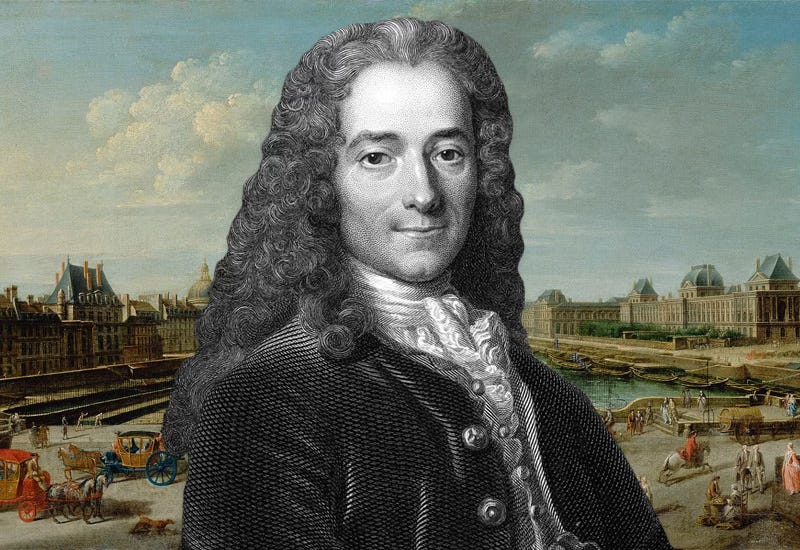
François-Marie Arouet, who renamed himself Voltaire long before he ever became famous, spent much of his life in motion. He was imprisoned in the Bastille, exiled from Paris, expelled from courts, driven across borders, and repeatedly entangled in fights with monarchs, priests, censors, and rival intellectuals. Even his fame had a volatile quality. He was praised and condemned with equal intensity. By the end of his life he was perhaps the most widely read writer in Europe, though he remained suspicious of permanence in nearly every form.
In a 1770 letter to Frederick William II of Prussia, Voltaire wrote that “doubt is not a pleasant state, but certainty is a ridiculous one.” That line appeared amid a dispute about religion and metaphysics, but it has outlived the argument it came from. Like many of Voltaire’s best remarks, it survives because it recognized something embarrassingly permanent about human beings: our desperate desire for stability in a world organized around movement.
Most people spend their lives trying to establish security against the battering-ram of change. We narrate our lives as though they are gradually arriving somewhere solid. Even the language of adulthood is architectural. We talk about being grounded, settled, rooted, established. A successful and stable life is imagined as one that finally stops moving.
There is a quieter, more contemporary version of this fantasy as well. Careers are often described as though they will unfold along a prewritten line — chosen in advance, followed with discipline, and eventually becoming complete. The uncertainty is treated as temporary, as if the shape of the story already exists somewhere offstage.
There is a certain innocence in this. Children tend to imagine adulthood as a completed condition. At some point, you will know who you are, what you believe, and where you belong. Even as we grow older, our concerns are strikingly similar. We are still learning how to be alive for the first time. Many people continue, in subtler ways, to hold onto that expectation long after experience has taught them otherwise. Uncertainty is treated less as a condition than as a delay.
Yet the strange thing, which becomes clearer with age, is that movement is the only reliable condition we ever actually experience. Friendships drift. Cities change. Lives shape-shift. Ambitions decay and then unexpectedly return in different forms. Entire worlds that once appeared fixed begin to look provisional within a decade. Who you were at twenty-five can become nearly unrecognizable in a few years.
But even memory moves. The past does not remain fixed behind us so much as it shifts in tone and proportion, edited by time without permission. Places we once loved become inaccessible except through increasingly unreliable acts of recollection. People survive within us long after they are gone, but not in the form they once were. You could wake up and find that an old grief has loosened, or that a forgotten desire has returned without warning. Much of life consists less as a continuity than as a reincarnated urge.
Voltaire understood that certainty is seductive precisely because the world itself refuses to stay still. Certainty offers us the illusion that we can stand outside of change. It suggests that something like God, ideology, identity, history, or even the future can be secured against the ripples of change. But life rarely grants us that kind of stability. What it offers instead are temporary arrangements, brief periods of coherence interrupted by movement, loss, discovery, reinvention, and return.
This is partly why doubt feels so unpleasant. Doubt is the moment when instability becomes visible. It is the recognition that the world exceeds the systems we build to contain it. But Voltaire’s deeper suggestion is that there is something slightly absurd about demanding permanence from a condition defined by change. The ridiculous posture is not hesitation. It is the belief that we might be exempt from revision, that we are immune from change.
Underneath this is a familiar hope: that instability might be managed into fixity through clarity, planning, or self-knowledge. If earlier centuries sought certainty through religion, the present often seeks it through psychology or productivity. The vocabulary changes but the roots remain the same.
Voltaire distrusted this impulse because he understood how quickly certainty can become a kind of arrogance. “There are only charlatans who are certain,” he wrote elsewhere in the same letter. The remark is harsh, but it carries a kind of proportion. We are finite, interpreting a world far larger than ourselves. Therefore, confusion is not an exception to that condition, but its chief expression.
What makes Voltaire endure is that his skepticism was never purely negative. He did not conclude the uncertainty makes happiness impossible. On the contrary, much of human suffering and misery arises from expecting life to behave as though it were stable. Often our lives are exciting when they are moving.
This is perhaps why at the ending of Voltaire’s only novel, Candide, still feels unexpectedly clear. After catastrophe, argument, and disillusionment, the novel ends not with a revelation but with an instruction: “we must cultivate our garden.”
The line is often taken as resignation, but it is closer to a kind of attention. A garden does not stabilize the world. It accepts its instability. It requires tending, not mastery. It grows and fails and regrows. It is never finished and is always in progress.
There is something quietly consoling in that image, because it shifts the meaning of happiness away from permanence. A livable life may not depend on resolving uncertainty, but on learning how to move within it without constant alarm.
Movement is difficult because it always carries loss. Each change closes other possibilities. To age is to watch versions of oneself disappear. To love someone is to accept the possibility that they too might change or that distance will grow between you and your loved one. Stability feels necessary because impermanence makes everything conditional.
And yet movement also enlarges. When you leave a place, you realize how much of your identity had been bound to geography. When you change direction, you truly see just how much of what felt fixed was only provisional. And when you survive something difficult, you get to discover that the self is more flexible than expected. Motion unsettles, but it also loosens.
Voltaire spent much of his life searching for a place where he could think without the motion of life. He never quite found one. Instead, he learned to build a livable existence within instability itself—through work, conversation, writing, friendship, irony, and carefully tended habits. “Earthly paradise is where I am,” he once wrote. The line is disarmingly simple, but it carries a specific kind of wisdom: happiness depends less on arrival than on attention.
Perhaps this is the quiet center of Voltaire’s suspicion of certainty. Human beings cannot remove instability from our lives. The future will not settle in advance. Relationships will not remain fixed. And yet we will continue to change whether or not we consent to it.
But we can become less startled by movement.
We can stop expecting adulthood, wisdom, or happiness to arrive in the form of final stability. When we recognize that doubt may simply be the feeling of thinking honestly inside a changing world, our lives change. And we can begin to slowly replace the fantasy of permanence with something more modest and more durable: attention, adaptability, curiosity, and the steady work of cultivating one’s garden while everything around us continues to shift.
It's all really ebb and flow isn't it? Between stillness and movement lies presence. I have been cultivating my garden, and am amazed when I see what grows with just a little bit of patience.